
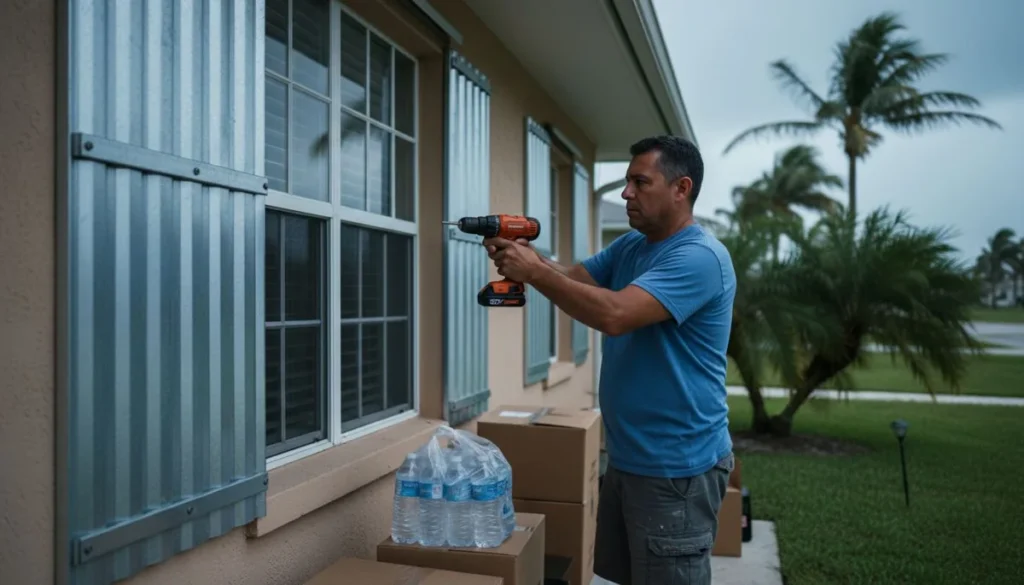
Hurricane season in Florida runs from June 1st to November 30th, and with the Tropical Storm Bertha Active in the Gulf this week makes it abundantly clear why taking timely precautions each year is what separates a family that survives from one that loses its home and savings. Prepare your home for hurricanes in Florida This isn't an exaggeration: it's about protecting your biggest investment before the next storm forms. In this guide in Spanish, we give you a clear, step-by-step plan to insure your home, assemble your emergency kit, review your policy in time, and act calmly when a hurricane is already on its way.
Tropical Storm Bertha in the Gulf: What to do now (updated July 21, 2026)
If you live in the Panhandle (Panama City, Tallahassee, Pensacola, and surrounding areas), the storm is hitting you close: the NHC anticipates a storm surge of 1 to 4 feet, 2 to 4 inches of rain with isolated higher accumulations, and dangerous rip currents along the northern Gulf Coast. Bertha is moving northwest at about 5 mph and is expected to turn west-northwest, so the greatest impact is on the Panhandle and the coasts of Alabama, Mississippi, and Louisiana, not the southern peninsula.
If you're in Miami, Hialeah, Orlando, or Tampa, you're not in the cone today, but this is exactly the week to do what almost no one does on time: Review your policy before the next one is formedWe're in the peak of the season and you're already on your second named system of the year.
What you can no longer change when the storm has a name
This is the point that costs people the most money. As soon as the NHC names a system that threatens the state, insurers in Florida activate what is known as subscription moratorium: You can't buy a new policy, increase your limits, or lower your deductible. until the event has passed. And flood insurance also has its own 30-day waiting periodBuying it today won't protect you from this storm.
What you can do right now, even though Bertha already has a name:
- Find out how much your hurricane deductible is. It's not a fixed amount: in Florida, it's usually a percentage of the home's insured value. Check your policy statement and calculate the actual number. We explain it in the guide. hurricane deductible in Florida.
- Photograph your house today, before the impact. Record video footage of every room, the roof, the patio, and the appliances with your cell phone. That footage is proof of the "before" and is invaluable when you file a claim.
- Keep your policy and documents in the cloud and in a waterproof bag, with your insurer's claim number noted separately.
- Secure the physical: Bring in patio furniture, install panels, prune loose branches, and fill the gas tank.
And if the storm causes damage, the order matters: document it, make only temporary repairs, and file a claim promptly. We detail it step by step in How to claim insurance after a hurricaneIf your house already has shutters or a reinforced roof, the wind mitigation inspection Your premium may go down next year. For questions about your insurer or a claim, the Florida Department of Financial Services handles consumer inquiries.
Why preparing your home for hurricanes in Florida is not optional
Florida experiences more major storms than any other state in the country. A mid-category hurricane can rip off roofs, shatter windows, and render your home uninhabitable in a matter of hours. That's why learning how to Prepare your home for hurricanes in Florida Planning ahead saves you money, stress, and, most importantly, keeps you and your family safe. Preparation involves two parts: what you do before before the season starts (check your house and your insurance) and what you do when There is already a named storm approaching.
Hispanic families sometimes postpone these steps because of the language barrier or not knowing where to begin. The good news is that with a clear checklist and a little time, any homeowner or renter can make their home much more secure.
Before the season: Check your home insurance in time
The first step to Prepare your home for hurricanes in Florida It's about making sure your policy is up to date and covers what you think it does. Do this in May or early June, because once a storm forms, insurers tend to freeze changes. Check these points:
- Your hurricane deductible: In Florida, it's separate from the regular deductible and is usually a percentage of the insured value (2%, 5%, or 10%). Confirm how much you would have to pay out of pocket before filing a claim.
- If you have flood insurance: your home insurance policy It does not cover the flood.Water rising from storm surges or rain requires a separate policy, almost always from the federal NFIP program, and has a waiting period. Read the deadlines in our guide. Flood insurance in Florida and its 30-day waiting period.
- The reconstruction value: that the policy covers the cost of rebuilding your house, not just what you paid for it.
- The age of your ceiling: That's the first thing the insurer looks at. If it's been around for years, learn about your rights in our guide. Home insurance for an old roof in Florida.
If you want to fully understand what your policy covers and how much it costs, check out our complete guide to home insurance in Florida.
How to prepare your home for hurricanes in Florida: the step-by-step checklist
This is a practical list that should be completed at the beginning of the season, calmly and without rushing:
- Inspect the roof: Check that no tiles are missing and that there are no leaks. A roof in good condition withstands the wind better and lowers your premium.
- Clean gutters and drains: The accumulated water causes damage and leaks during the storm.
- Pruning trees and branches: Branches near the house become projectiles in strong winds. Cut them back before the season.
- Secure garage doors: They are one of the weakest points. If the wind gets in there, it can lift the roof from the inside.
- Install window guards: Shutters, aluminum panels, or impact-resistant glass. It's the investment that offers the most protection.
- Identify loose objects in the yard: Furniture, flower pots, the grill, and the trash can all need a place to be stored quickly.
Many of these improvements not only protect your home, they can also lower your mortgage premium. wind mitigation inspection in Florida It documents these protections and usually gives the biggest discount available on your home insurance.
Protects windows, roof and doors: physical shielding
The wind enters through the weakest point and, once inside, pushes the roof upwards. That's why sealing openings is central to any plan for Prepare your home for hurricanes in Florida:
- Windows: Ideally, use impact-resistant glass or permanent shutters. Otherwise, use well-anchored aluminum or 5/8″ plywood panels. Use X-shaped adhesive tapes. No They are useful, it's a myth.
- Garage door: Reinforce it with an approved bracing kit or replace it with a wind-resistant one.
- Ceiling: Check the hurricane straps and seal any leaks. A new, well-secured roof makes all the difference.
- Double and entrance doors: Add pins at the top and bottom to prevent the wind from opening them.
The Federal Emergency Management Agency offers official preparedness guides in Spanish that are worth reviewing at Ready.gov.
Assemble your emergency kit and store your documents
In addition to securing the structure, your plan to Prepare your home for hurricanes in Florida It must include provisions for at least seven days without electricity or running water:
- Water: one gallon per person per day, minimum for seven days.
- Non-perishable food, manual can opener, and pet food.
- Flashlights, battery-powered radio and spare batteries (avoid candles).
- First aid kit and prescription medicines.
- Cash in small bills: ATMs and cards may not work.
- Portable chargers charged and a full tank of gas in the car.
Equally important: keep copies of your ID, insurance policy, house deeds, and important phone numbers in a waterproof bag and also on your phone or in the cloud. Take photos and videos of each room and your belongings. before from the storm; that greatly speeds up any claim afterwards.
When the storm approaches: the last 72 hours
When the National Hurricane Center issues a warning for your area, take action. Follow official forecasts on the National Hurricane Center and always heed your county's evacuation orders:
- 72 hours prior: Fill up your gas tank, stock up on medications, and check your emergency kit. Confirm your evacuation plan and where you would go.
- 48 hours prior: Install the shutters or panels. Charge all devices. Set the refrigerator to the coldest setting.
- 24 hours prior: Bring everything from the yard inside. Move valuables upstairs if there is a risk of flooding. Fill the bathtub with water for essential uses.
- If you are ordered to evacuate: Do it early and without hesitation. Your house can be rebuilt; your life cannot.
After the hurricane: how to file your insurance claim
When it's safe to return, document everything before cleaning. These steps protect your right to a fair claim:
- Take photos and videos of all the damage before moving or throwing anything away.
- Make temporary repairs to prevent further damage (cover the roof with a tarp) and keep the receipts.
- Call your insurer or agent as soon as possible to open the claim.
- Do not sign Assignment of Benefits (AOB) agreements with contractors who knock on your door without verifying them.
You can check your rights as an insurance consumer at the Florida Department of Financial Services and verify that any company is authorized in the Florida Bureau of Insurance Regulation (FLOIR).
Why a local Spanish-speaking agent is right for you
Revisar tu cobertura a solas y en inglés es donde mucha gente se equivoca: no entiende el deducible de huracán, no sabe que la inundación va aparte y descubre las exclusiones cuando ya es tarde. Un agente independiente y local te explica cada cobertura en español, revisa que el valor de reconstrucción sea correcto, te consigue los descuentos por mitigación y compara varias compañías por ti sin costo adicional. En YR Insurance Services llevamos años ayudando a familias hispanas a proteger su casa antes de cada temporada de huracanes. Para conocer todas tus opciones, visita nuestra Complete guide to home insurance in Florida.
Is your home insurance ready for the season?
We'll review your policy for free, confirm your hurricane deductible, apply all mitigation discounts, and explain each coverage in Spanish before the storm hits. The quote is free.
Calendar to prepare your home for hurricanes in Florida
This table summarizes, in general terms, what you should do at each point in the season. Use it as a quick guide so you don't miss anything.
| Moment | To do |
|---|---|
| Start of season (May-June) | Review the policy, deductible, and flood insurance; inspect the roof and trim trees |
| 72 hours before | Fill up with gas, stock up on medicine, and check the emergency kit |
| 48-24 hours before | Install shutters, charge devices, and bring items in from the yard |
| After the storm | Document damages with photos, make temporary repairs, and file a claim. |
Common mistakes when preparing your home for hurricanes
- Waiting until the last minute: Materials run out and insurers freeze changes when there is already a named storm.
- Believing that home insurance covers flooding: They are different policies and water damage coverage is almost never included in the basic policy.
- Use adhesive tape on windows: It does not protect against impact; you need impact-resistant panels or glass.
Frequently asked questions about preparing your home for hurricanes in Florida
When should I start preparing my home for hurricane season?
Ideally, you should do this in May or early June, before the season officially begins on June 1st. Reviewing your insurance and reinforcing your home in advance will prevent you from being caught unprepared in a storm and unable to make necessary repairs, because insurance companies typically freeze policies when a hurricane is approaching.
Does my Florida home insurance cover hurricane damage?
Hurricane wind damage is usually covered, but subject to a special hurricane deductible, which is a percentage of the insured value. Flooding from storm surge or rain rising from outside is not covered by a homeowners policy; for that, you need a separate flood insurance policy, almost always from the federal NFIP program.
Does putting tape on windows before a hurricane help?
No. It's a very common myth. X-shaped tape doesn't prevent glass from shattering due to impact debris and can actually create larger, more dangerous shards. Real protection comes from shutters, aluminum panels, securely anchored plywood, or impact-resistant glass.
What should I have in my hurricane emergency kit?
Water for at least seven days (one gallon per person per day), non-perishable food, flashlights, a battery-powered radio, batteries, a first-aid kit, medications, cash in small bills, and portable chargers. Also, keep copies of your important documents and your insurance policy in a waterproof bag and in the cloud.
What do I do with my insurance right after the hurricane?
Document all damage with photos and videos before cleaning, make temporary repairs to prevent further damage and keep the receipts, and call your insurance company or agent as soon as possible to file a claim. Be wary of contractors who knock on your door asking you to sign Assignment of Benefits (AOBs) without verifying them.
Por el equipo de YR Insurance Services — Independent Spanish-speaking insurance agency, licensed in Florida. We serve Hialeah, Miami-Dade, and all of Florida, and we review your coverage to ensure your home is protected every hurricane season.
Official sources: FEMA (Ready.gov), National Hurricane Center (NOAA), Florida Office of Insurance Regulation (FLOIR), and Florida Department of Financial Services (MyFloridaCFO) — June 2026. This article is for informational purposes only; we do not handle government procedures and it is not a substitute for personalized insurance advice.
Sobre YR Insurance Services
EN YR Insurance Services For 14 years, we've been protecting Hispanic families in Florida. As an independent insurance agency, we compare over 100 companies to get you the best rates on auto, home, business, health, or life insurance. Learn why thousands of Hispanics in Florida choose us. YR Insurance Services year after year. Cotiza gratis con YR Insurance Services Right now — we provide 100% Spanish-speaking service.