
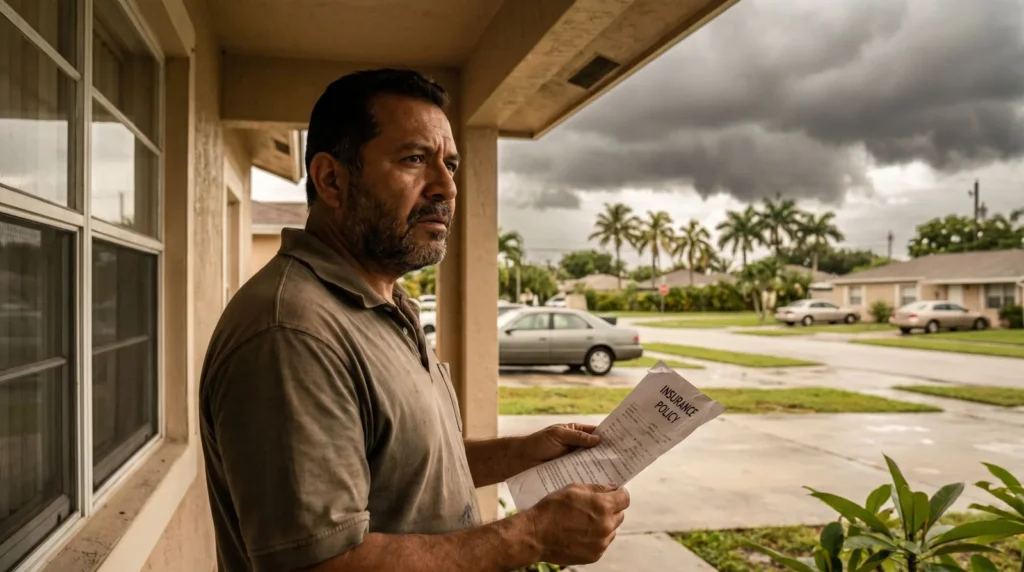
He Florida flood insurance waiting period It's a 30-day period, and that's precisely the detail people often discover too late: the 2026 hurricane season officially began on June 1st, and if you buy flood insurance when a tropical wave is already on the radar, it's highly likely your policy will NOT cover that hurricane. Coverage doesn't activate the day you pay. It activates 30 days later. In this guide, I'll explain how that 30-day clock works, the four real exceptions that do exist, why a "below average" hurricane season forecast won't protect you at all, and what you need to do today to avoid being left out.
I see it every year with families in Hialeah, Doral, and Homestead. The first storm warning comes on the news, everyone rushes to buy flood insurance, and they all hit the same wall: "Ma'am, this doesn't take effect for another 30 days." By then, it's too late. That's why June, before the first serious storm hits, is the only comfortable window you have.
What is the 30-day waiting period for flood insurance?
When you buy a policy from the National Flood Insurance Program (NFIP), the federal flood insurance program, coverage doesn't start immediately. There is a 30-day waiting period between the day you pay and the day the policy actually covers you. If a flood or hurricane hits you within those 30 days, the claim is denied. Period.
The reason is logical from the insurer's perspective: the waiting period prevents people from buying flood insurance only after the water has already arrived, collecting the payout, and then canceling. But for you, as a homeowner in South Florida, it means one very concrete thing: The time to buy is BEFORE the storm forms, not when they're already announcing it.Look at the numbers: if you buy today, June 8th, you're protected around July 8th. If you wait for a system to enter the Gulf at the end of June, you'll miss out.
This detail applies equally throughout Florida, as confirmed by the federal program itself. FloodSmart.gov, the official NFIP websiteIt's not a YR rule or a company rule: it's a federal rule.
The 4 real exceptions to the waiting period
However, there are four situations where the 30-day waiting period does NOT apply or is reduced to one day. This is something almost no one explains in Spanish, and sometimes it saves you:
- Purchase linked to a mortgageIf you buy, increase, extend, or renew a mortgage and purchase flood insurance during that process, the coverage takes effect immediately, without waiting 30 days. This is the most common exception when closing on a home purchase.
- Renewal or change of coverageIf you already have an active policy and you change or increase the coverage when you renew, that adjustment takes effect without the full waiting period.
- Newly designated flood zoneIf FEMA updates the map and your property falls into a new high-risk zone, and you purchase within 12 months of the change, the waiting period decreases to just one day.
- Flooding caused by fire on federal landIf the flooding is caused or worsened by a fire on federal land, and you make purchases within 60 days of the fire being contained, it's also a one-day waiting period. This rarely applies in Miami-Dade, but it does exist.
Focus on what's important: None of these exceptions will help you if you simply "forgot" and the storm is already comingBuying at the last minute because a hurricane is in the forecast is not an exception. It's exactly the case that the waiting period is designed to block.
"The season is below average": why that doesn't save you
The seasonal forecast is released every June, and 2026 is no different. NOAA predicted a below-normal seasonThe forecast calls for 8 to 14 named storms, 3 to 6 hurricanes, and 1 to 3 major hurricanes. Colorado State University (CSU) predicted 13 named storms. The factor behind the low number is El Niño, which brings more wind shear and makes it harder for storms to organize.
It sounds reassuring. And therein lies the trap. A low forecast tells you the total number of storms across the Atlantic over six months. It tells you nothing about your house. Your roof in Hialeah Gardens doesn't care if there were 8 or 18 storms in the year; it cares if one passed over you. Hurricane Andrew, in 1992, occurred during what was considered a quiet season and devastated South Miami-Dade.
In other words: the season's number is just noise when it comes to your decision. The only thing that matters is whether you have active coverage when the water arrives. And there's a 30-day difference between "I'll wait and see how the season goes" and a denied claim for buying too late.
Flood coverage is NOT included in your home insurance (this is the expensive mistake)
There's a confusion here that's costing thousands of dollars. The vast majority of policies... Home insurance in Florida does NOT cover flooding.Your homeowners insurance covers wind damage, hurricane damage (if your roof tiles are ripped off), and damage from a tree falling on your roof. But water coming in from outside (storm surge, flooding, or water from a flooded street entering through your door) is flood damage, and that's covered under a separate policy.
Many families in the 33015 or 33012 zip codes only find this out the day they file a claim. They thought the hurricane was covered, and it turns out that while the wind was, the 18 inches of water that damaged their floors, walls, and furniture wasn't. That's why, if you live in a low-lying area or near canals, flood insurance isn't optional, even if the bank doesn't require it.
If you want to understand how flooding fits into the rest of your protection, you should first review your home insurance in Florida and see what you have and what you're missing. An independent broker puts together the complete package for you: homeowners + flood insurance, with no gaps.
The season has already started. Start your 30-day clock today.
We'll get you quotes for flood insurance and home insurance in Florida from several companies to find you the best price before the first storm hits. 100% in Spanish, fast, and free.
How much does flood insurance cost in South Florida?
The price depends on your property's flood zone, elevation, home value, and the amount of coverage you choose. To give you a realistic range of what I foresee in Miami-Dade in 2026:
- Low to moderate risk zone (X zones)Many homes qualify for "preferred risk" policies that start in the $400 to $700 per year range. These are the cheapest, and many people in Zone X don't even know they qualify.
- High risk zone (AE, VE zones)Here's where it goes up. Depending on elevation and coverage, it can range from $1,200 to over $3,000 per year.
- Maximum NFIP CoverageThe federal program caps at $250,000 for the structure and $100,000 for contents. If your house is worth more, that's where private flood insurance comes in, which can cover higher amounts.
The NFIP now uses a pricing system called Risk Rating 2.0, which charges based on the actual risk of YOUR address, not a generic map. That's why two houses on the same block can pay different rates. The only way to know your exact rate is to get a quote with your specific address.
NFIP vs. private flood: which one is right for you
You have two ways to buy flood insurance in Florida, and the federal way isn't always the best:
- NFIP (federal)The tried-and-true program. Stable, accepted by any bank for mortgages, with limits of $250,000 for the structure and $100,000 for the contents. It has a 30-day waiting period.
- Private FloodPrivate companies that have entered the Florida market aggressively in recent years. Sometimes they're cheaper, sometimes they offer higher limits than the NFIP cap, and some have shorter waiting periods. But you have to read the fine print and confirm that the bank will accept it.
For a family with a mid-range home in area X, the NFIP preferred risk is often the cheapest option. For an expensive home near the water, the private option might offer better coverage. There's no single answer: it depends on your address, your mortgage, and your budget. A broker who quotes both options saves you the headache of comparing them individually.
What a flood insurance policy covers (and what it does NOT cover).
To avoid surprises on claim day, here's what's typically included and what's not in a standard NFIP policy:
- Yes, it covers it.: structural water damage (walls, floors, foundations), electrical and plumbing systems, water heater, central ovens and A/C, built-in appliances, and within the contents, furniture and electronics up to the limit you purchase.
- It does NOT cover (without extra endorsements): cash, valuable documents, damage to the pool or garden, vehicles (that's covered by your car insurance), and very importantly: most of the contents of a basement or lower level It has limited coverage.
- Loss of useThe NFIP typically does NOT cover hotel or living expenses while repairs are being done. Private policies sometimes do. Details to be confirmed.
If you keep valuables downstairs or run a home-based business, it's worth discussing endorsements or private flood insurance to cover what the federal system leaves out.
Your action plan for June 2026
Now that the season has started and the 30-day clock is ticking, here's what you should do this week, in order:
- Find out your flood zoneCheck the FEMA map for your address. That determines your price and whether the bank requires it.
- Get a quote TODAY, not in JulyEvery day you wait is another day it takes to be covered. Buying on June 8th protects you until around July 8th; buying on July 1st leaves you uncovered for a good part of the month.
- Compare NFIP and privateAsk for quotes from both. The price difference can be hundreds of dollars a year.
- Check your home insurance at the same timeConfirm that your homeowners insurance is up to date and that the hurricane deductible (the "named storm deductible") won't catch you off guard. If you need to bolster other coverages, now is a good time; you might find it helpful to read about [the relevant sections/topics]. New insurance companies in Florida 2026 and how to know which one is stable.
- Don't wait for the bank letterIf your home is worth more than a certain amount, Citizens and several carriers already require flood insurance. Get ahead of the game before they force it on you.
To verify your official flood zone and understand the program requirements, you can consult directly FEMA's Flood Insurance page, the federal agency that administers the NFIP.
The 30-day waiting period for flood insurance, in a table
Flood insurance doesn't take effect the same day you purchase it. In most cases, there's a standard 30-day waiting period before coverage becomes effective. This table summarizes the most common situations so you know what to expect; always confirm your specific case with your agent or your policy.
| Situation | When does coverage usually start? |
|---|---|
| New purchase without a loan involved | Approximately 30 days after paying the policy |
| Required by the bank when closing a mortgage | It is usually activated at the same time as the closure, without waiting 30 days. |
| Renewal of an existing policy | Continue without a new waiting period if there was no lapse |
| Change or increase in coverage | The increase may have its own waiting period, depending on the case. |
| Area recently reclassified on the risk map | You can apply a reduced window; check your case. |
Common mistakes
- Don't wait for hurricane season: Many hire when there is already a system in formation and the 30-day period leaves the property without coverage.
- Assuming home insurance covers flooding: Most standard policies exclude flood damage; it is a separate coverage.
- Not documenting the start date: Keep a written record of when it takes effect to avoid disputes in a claim.
Frequently asked questions about flood insurance and the waiting period
Why does flood insurance take 30 days to activate in Florida?
The NFIP, the federal flood insurance program, has a 30-day waiting period between the day you pay and the day the coverage takes effect. This is to prevent people from buying coverage only after a hurricane is approaching, collecting the payout, and then canceling. That's why you need to buy BEFORE the storm forms: if you buy today, June 8th, you'll be protected around July 8th. Buying at the last minute when the storm is already on the radar doesn't work.
Is there a way to avoid the 30-day waiting period?
Yes, in four specific cases: when you purchase flood insurance tied to a new or renewed mortgage (it takes effect immediately), when you adjust coverage upon renewing an existing policy, when your property falls within a newly designated FEMA high-risk zone and you purchase within 12 months (one-day waiting period), or when the flooding results from a fire on federal land (one-day waiting period). Purchasing late because a storm is approaching is NOT an exception.
If the 2026 hurricane season is "below average," do I still need flood insurance?
Yes. The forecast tells you about the total number of storms across the Atlantic, not your house. Your roof doesn't care if there were 8 or 18 storms; it cares if ONE passed over you. Hurricane Andrew in 1992 occurred during what was considered a quiet season and devastated South Miami-Dade. Just one storm is enough to make you need to be covered.
Does my Florida home insurance already cover flooding?
Almost never. Most homeowners insurance policies in Florida cover wind and hurricane damage to the roof, but NOT water rising from outside (storm surge, flooded streets, overflow). That's covered by a separate flood insurance policy, either federal or private. Many people only find out the day they file a claim, when it's already too late.
How much does flood insurance cost in Miami-Dade in 2026?
It depends on your location, elevation, and coverage. In low-risk areas (Zones X), many homes qualify for preferred risk policies costing $400 to $700 per year. In high-risk areas (AE, VE), it can range from $1,200 to over $3,000. The NFIP caps at $250,000 for structure and $100,000 for contents; if your home is worth more, you should consider private flood insurance. The only way to know your exact amount is to get a quote with your address.
Sources: National Flood Insurance Program (FloodSmart.gov), FEMA Flood Insurance, NOAA 2026 Atlantic Hurricane Season Outlook, Colorado State University (CSU) Tropical Weather & Climate Research — June 2026.
Sobre YR Insurance Services
EN YR Insurance Services For 14 years, we've been protecting Hispanic families in Florida. As an independent insurance agency, we compare multiple companies to get you the best rates on flood, home, auto, business, health, or life insurance. Learn why thousands of Hispanics in Florida choose our services. YR Insurance Services en español year after year. Cotiza gratis con YR Insurance Services Right now — we provide 100% Spanish-speaking service.